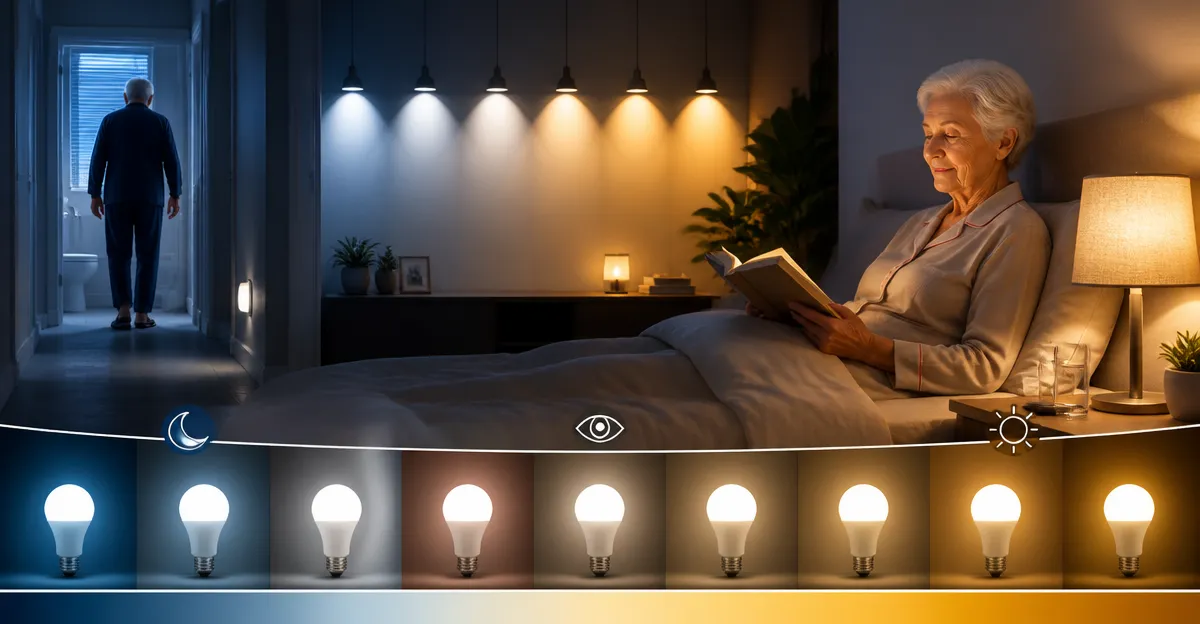
The Ultimate Guide to Lighting Color Temperature for Seniors: Improve Night Visibility and Sleep
Introduction
Lighting plays a critical role in the daily lives of seniors, influencing both safety and sleep quality. This guide explains how color temperature affects visual comfort, night navigation, and circadian rhythms for older adults. Readers will learn foundational concepts, practical strategies, and product recommendations that support healthier lighting environments. By the end of this article, one will be equipped to select lighting that enhances visibility at night while promoting restorative sleep.
Background and Context
Color temperature is measured in kelvin (K) and describes the hue of light emitted by a source. Lower values, such as 2700K, produce warm, yellow‑ish light, while higher values, such as 5000K, emit a cool, bluish tone. Human eyes respond differently to these spectra, especially as the lens ages and the retina becomes less sensitive to blue light. Understanding this physiological shift is essential when designing lighting for seniors.
Research indicates that exposure to cool, blue‑rich light in the evening can suppress melatonin production, delaying sleep onset. Conversely, warm light in the evening supports natural melatonin release, facilitating a smoother transition to sleep. During nighttime activities, sufficient illumination is required to prevent falls, but the light must not be so bright or cool that it interferes with circadian cues.
Modern LED technology allows precise control over both intensity and color temperature, offering a range of options from soft white (2700K) to daylight (5000K). Seniors can benefit from fixtures that provide the appropriate hue at the right time of day. The following sections break down these concepts and present actionable recommendations.
Understanding Color Temperature and Its Impact on Seniors
Warm white light (2700K‑3000K) mimics the glow of traditional incandescent bulbs and creates a cozy atmosphere. For seniors, this range reduces glare, eases eye strain, and aligns with the body’s natural evening rhythm. Soft white LEDs are therefore ideal for living rooms, bedrooms, and hallways used after sunset.
Cool white or daylight light (4000K‑5000K) closely resembles natural daylight and enhances contrast, making it valuable for task‑oriented spaces such as kitchens and reading areas during the day. However, using daylight LEDs in the evening can delay sleep onset due to their higher blue light content.
When selecting bulbs, one should consider the time of use, the activity performed, and the visual acuity of the senior. A balanced lighting plan typically employs warm light in the evening and cooler light during daylight hours.
Recommended Products for Senior Lighting
Two LED products reviewed in this guide demonstrate how different color temperatures can be applied effectively. The first product provides a warm, soft‑white output suitable for evening environments, while the second offers a bright daylight hue for daytime tasks.
Sylvania Soft White LED Bulb delivers 2700K illumination, 800 lumens, and an 8.5W power draw, replicating a 60W incandescent bulb. It is rated 4.7 out of 5 stars based on 40,304 reviews and is priced at $19.63 for a 24‑pack. Its long lifespan of 11,000 hours and energy‑saving design make it an excellent choice for bedrooms and hallways used after dark.
Energetic Daylight LED Bulb provides a 5000K daylight spectrum, 760 lumens, and an 8W consumption, also equivalent to a 60W incandescent. With a rating of 4.7 out of 5 stars from 21,600 reviews and a price of $20.49 for a 24‑pack, it excels in kitchens, workspaces, and reading corners during daylight hours.
Both products are mercury‑free, non‑toxic, and designed to reduce energy costs by up to 85 %. Their instant‑on performance eliminates warm‑up delays, ensuring immediate illumination when needed.
Comparison and Selection Guide
| Product | Color Temperature | Wattage (W) | Lumens | Lifespan (hours) | Price (per 24‑pack) | Rating |
|---|---|---|---|---|---|---|
| Sylvania Soft White LED Bulb | 2700K (Soft White) | 8.5 | 800 | 11,000 | $19.63 | 4.7/5 (40,304 reviews) |
| Energetic Daylight LED Bulb | 5000K (Daylight) | 8 | 760 | 15,000 | $20.49 | 4.7/5 (21,600 reviews) |
When choosing a bulb, seniors should prioritize warm‑white options for evening use to support melatonin production, and daylight options for daytime tasks that require visual acuity. Energy consumption, lifespan, and user reviews provide additional decision criteria.
Best Practices & Tips for Senior Lighting
- Install dimmable warm‑white LED fixtures in bedrooms and hallways to allow gradual reduction of light intensity before sleep.
- Use motion‑sensor nightlights with a 2700K hue to illuminate pathways without requiring seniors to locate a switch.
- Reserve daylight‑temperature bulbs for kitchens, worktables, and reading chairs used during daylight hours.
- Replace all incandescent bulbs with LED equivalents to reduce heat output and lower the risk of burns.
- Consider smart lighting systems that automatically adjust color temperature based on the time of day, providing seamless transitions.
Regularly cleaning lamp shades and fixtures improves light distribution and reduces glare. Positioning light sources at eye level minimizes shadows that can cause disorientation. Finally, ensure that any new bulbs are compatible with existing fixtures and do not exceed the maximum wattage rating.
Frequently Asked Questions
- Why does warm light help seniors sleep better? Warm light contains less blue wavelength, which minimally suppresses melatonin, the hormone that regulates sleep cycles.
- Can I use daylight bulbs in the evening if I need more brightness? It is advisable to limit daylight bulbs after sunset; instead, increase the number of warm‑white fixtures or use a higher lumen warm bulb.
- Do LED bulbs generate heat that could be uncomfortable? LEDs emit significantly less heat than incandescent bulbs; the modest warmth they produce is generally safe for seniors.
- Are LED bulbs safe for people with sensitive eyes? LEDs that are flicker‑free and free of ultraviolet (UV) and infrared (IR) radiation, such as the products featured, are safe for most users.
- How often should I replace LED bulbs? With lifespans of 11,000‑15,000 hours, LEDs typically last many years; replacement is only necessary when brightness diminishes or the bulb fails.
- Is it necessary to purchase a dimmer compatible with LEDs? Yes, using a dimmer rated for LED technology ensures smooth dimming without flicker or buzzing.
- Can smart bulbs improve senior safety? Smart bulbs can be programmed to turn on at preset times, simulate sunrise, or respond to motion, thereby enhancing safety and comfort.
Conclusion
Understanding and applying the correct color temperature is essential for improving night visibility and sleep quality among seniors. Warm‑white LEDs such as the Sylvania Soft White LED Bulb support evening relaxation, while daylight LEDs like the Energetic Daylight LED Bulb enhance daytime tasks. By following the best‑practice recommendations and using the comparison guide, seniors and caregivers can create lighting environments that are safe, energy‑efficient, and conducive to healthy sleep patterns.
Products Featured in This Guide
Sylvania Soft White LED Bulb
Price: $19.63 (24‑pack) | Rating: 4.7/5 (40,304 reviews)
Featured because it provides a 2700K warm hue, 800 lumens, and an 11,000‑hour lifespan, making it ideal for evening spaces that support senior sleep hygiene.
Energetic Daylight LED Bulb
Price: $20.49 (24‑pack) | Rating: 4.7/5 (21,600 reviews)
Featured because it offers a 5000K daylight spectrum, 760 lumens, and a 15,000‑hour lifespan, which is optimal for daytime tasks that require clear, crisp illumination.