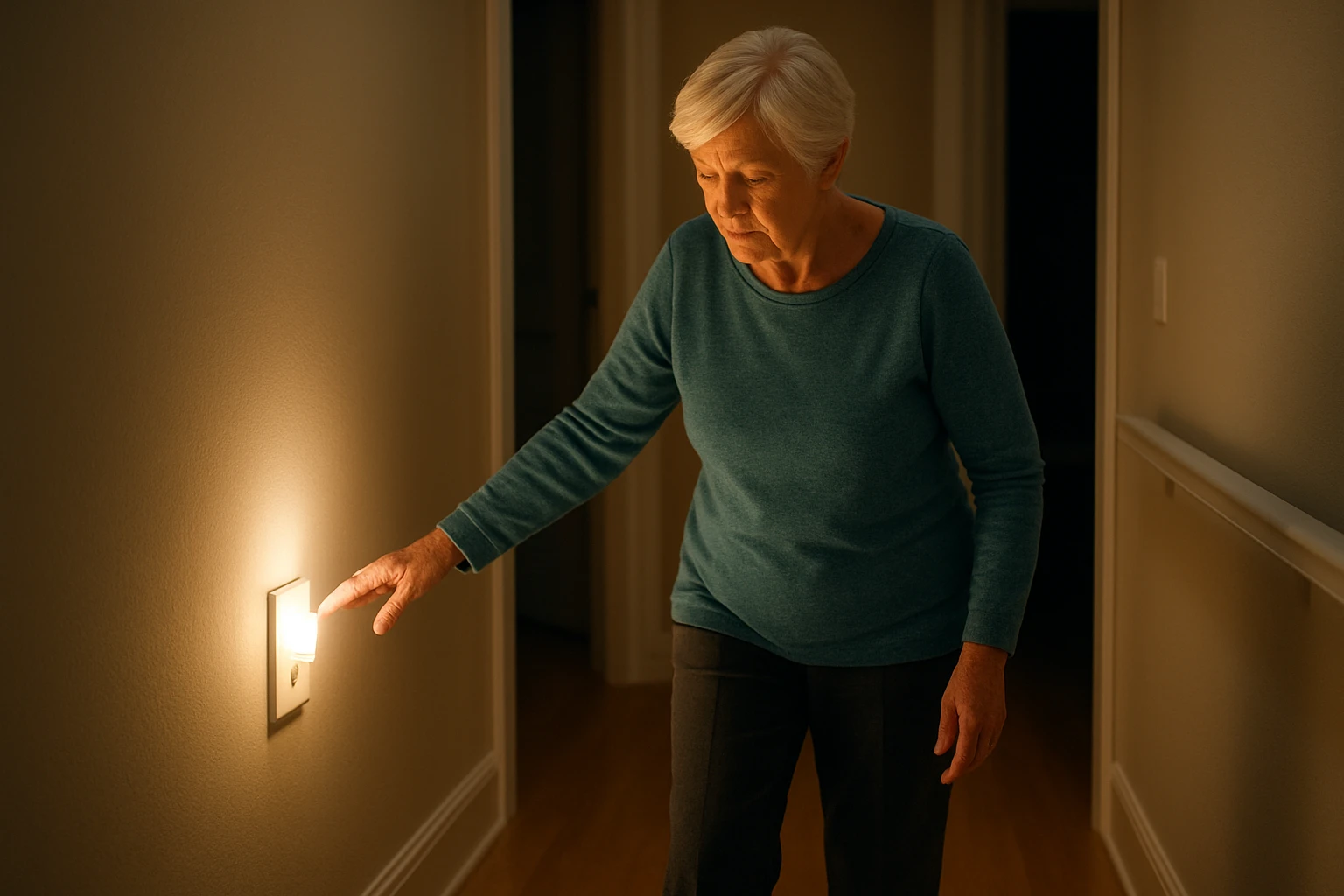

Where to Place Night Lights to Prevent Senior Falls: A Room-by-Room Guide for Safer Homes
Introduction
Falls are a leading cause of injury among older adults, and inadequate lighting is a common contributing factor. This guide explains how strategic placement of night lights can dramatically reduce the risk of nighttime trips and slips. Readers will learn the science behind low‑level illumination, discover room‑specific placement strategies, and receive curated product recommendations that balance cost, energy efficiency, and ease of use.
By the end of this article, one will be equipped to assess a home, select appropriate night‑lighting solutions, and implement a plan that promotes independence and confidence for seniors.
Background/Context
Human vision relies on two systems: photopic vision for bright conditions and scotopic vision for darkness. In low‑light environments, the eyes use rod cells, which are highly sensitive but cannot discern color or fine detail. Older adults experience a natural decline in rod density and pupil dilation, making it harder to adapt to sudden darkness.
Research from the National Institute on Aging indicates that a modest increase in ambient light—approximately 10‑15 lux—can improve contrast perception and reduce missteps. Night lights that provide a soft, steady glow without glare are therefore essential in high‑traffic zones such as hallways, staircases, and bathrooms.
When selecting night lights, consider three technical criteria: luminous output (measured in lumens), power consumption (watts), and sensor functionality (motion‑activated, dusk‑to‑dawn, or manual). The products featured below meet these criteria while offering user‑friendly controls.
Living Room and Hallways
The living room often serves as a central hub, and hallways connect it to bedrooms and bathrooms. A motion‑activated night light placed near the entry point can illuminate the path only when needed, conserving energy and avoiding constant glare.
MAZ-TEK Motion Sensor Night Light is ideal for this setting. It offers three brightness levels (4, 8, and 15 lumens) and a detection range of up to 12 feet at a 120° angle. The AUTO mode ensures the light activates only in darkness, turning off after 30 seconds of inactivity, which minimizes disruption to sleep cycles.
Key specifications:
- Price: $9.99 for a 2‑pack
- Rating: 4.6/5.0 from 8,076 reviews
- Power consumption: 0.5 W per unit (approximately $0.20 per year)
- Installation: Plug‑in, no wiring required
Place one unit near the main hallway light fixture and the second near the living‑room sofa or recliner where seniors often sit and rise.
Staircase
Staircases present the highest fall risk, especially when steps are poorly lit. A low‑profile night light that activates with motion can illuminate each step as the senior ascends or descends.
The MAZ-TEK Motion Sensor Night Light can be installed on the landing at the base of the stairs. Its three brightness settings allow selection of a subtle glow that highlights step edges without creating harsh shadows.
Installation tip: Position the sensor facing upward toward the stair tread to maximize detection range. If the staircase has a narrow landing, consider using both units—one at the top and one at the bottom—to provide continuous illumination.
Bedroom and Bathroom
Nighttime trips to the bathroom are a common source of falls. Seniors often need to locate the toilet, sink, or bedside rail in near darkness. A night light with a soft, warm white output reduces eye strain while still providing enough contrast.
The Briignite LED Night Light delivers a 5000 K daylight white glow at only 0.3 W, making it energy‑efficient and gentle on the eyes. Its built‑in light sensor automatically switches on at dusk and off at dawn, ensuring the bathroom remains illuminated throughout the night without manual intervention.
Key specifications:
- Price: $11.99 for a 2‑pack
- Rating: 4.6/5.0 from 916 reviews
- Lifespan: >30,000 hours
- Design: Square plug‑in that occupies minimal outlet space
Place one unit on the bathroom outlet adjacent to the vanity mirror and the second near the night‑stand in the bedroom. The soft daylight hue helps seniors gauge depth without disrupting melatonin production.
Kitchen and Utility Areas
Late‑night trips to the kitchen for water or medication can be hazardous if countertops are dark. A night light with a modest brightness level can outline countertops and appliance controls.
Both the MAZ-TEK Motion Sensor Night Light and the Briignite LED Night Light are suitable. For kitchens with limited outlet space, the square form factor of the Briignite model frees a second socket for a toaster or coffee maker.
Recommendation: Use the motion‑activated mode of the MAZ‑TEK unit near the pantry entrance, and the dusk‑to‑dawn mode of the Briignite unit above the sink to provide constant low‑level illumination.
Comparison/Selection Guide
| Feature | MAZ-TEK Motion Sensor Night Light | Briignite LED Night Light |
|---|---|---|
| Brightness Levels | 3 (4, 8, 15 lumens) | Fixed 5000K daylight white (approx. 5‑7 lumens) |
| Power Consumption | 0.5 W per unit | 0.3 W per unit |
| Sensor Type | Motion + AUTO/DAY/NIGHT modes | Dusk‑to‑dawn light sensor |
| Installation | Plug‑in, external controls | Plug‑in, compact square design |
| Price (2‑pack) | $9.99 | $11.99 |
| Average Rating | 4.6/5 (8,076 reviews) | 4.6/5 (916 reviews) |
When choosing a product, consider the desired level of automation, the available outlet space, and the preferred light temperature. Motion‑activated units excel in high‑traffic zones, while dusk‑to‑dawn lights are best for areas where continuous low‑level illumination is preferred.
Best Practices & Tips
- Install night lights at a height of 4‑6 feet to illuminate the floor without causing glare.
- Use the lowest brightness setting that still provides sufficient contrast; higher lumens can interfere with night‑time vision.
- Test sensor range after installation; ensure the motion detector covers the entire pathway.
- Combine night lights with non‑slip flooring or adhesive grip strips for added safety.
- Regularly clean the lenses of sensor‑based lights to prevent dust from reducing detection accuracy.
- Consider battery‑back‑up models for areas prone to power outages.
Frequently Asked Questions
- 1. Do motion‑sensor night lights work with pets?
- Yes, but some models allow sensitivity adjustment. The MAZ‑TEK unit can be set to ignore small movements, reducing false activations caused by cats or dogs.
- 2. How much does a night light increase electricity costs?
- Both featured products consume less than 0.5 W. Operating continuously for a year costs under $0.20, making them virtually cost‑free.
- 3. Can night lights be used with dimmer switches?
- Plug‑in night lights are independent of wall dimmers. Installing a dimmer on the same circuit may affect sensor performance; it is best to keep them on a standard outlet.
- 4. Are there any health concerns with blue‑light night lights?
- Blue light can suppress melatonin. The MAZ‑TEK emits a warm white glow, while the Briignite provides a neutral daylight white (5000 K). For seniors sensitive to blue light, the warm setting of MAZ‑TEK is preferable.
- 5. How often should night lights be replaced?
- LED night lights typically last 30,000‑50,000 hours. At an average of 4 hours per night, a unit can function for over 20 years before dimming occurs.
- 6. Is it safe to use night lights in bathrooms?
- Both products are rated for indoor use and have low power consumption, reducing fire risk. However, ensure the outlet is GFCI‑protected as required by electrical codes.
Conclusion
Strategic placement of night lights is a low‑cost, high‑impact intervention to reduce senior falls. By understanding visual physiology, selecting appropriate illumination levels, and deploying motion‑ or sensor‑based devices in key locations, one can create a safer home environment that supports independence.
Both the MAZ‑TEK Motion Sensor Night Light and the Briignite LED Night Light meet the essential criteria of affordability, energy efficiency, and ease of installation. Implement the room‑by‑room recommendations, follow the best‑practice checklist, and regularly reassess lighting conditions as needs evolve.
Products Featured in This Guide
MAZ-TEK Motion Sensor Night Light
Price: $9.99 (2‑pack) | Rating: 4.6/5.0 (8,076 reviews)
Featured because it offers adjustable brightness, motion activation, and a wide detection range, making it suitable for hallways, staircases, and living areas.
Briignite LED Night Light
Price: $11.99 (2‑pack) | Rating: 4.6/5.0 (916 reviews)
Featured because its dusk‑to‑dawn sensor and ultra‑low power draw provide continuous, gentle illumination ideal for bedrooms, bathrooms, and compact kitchen outlets.
