Introduction
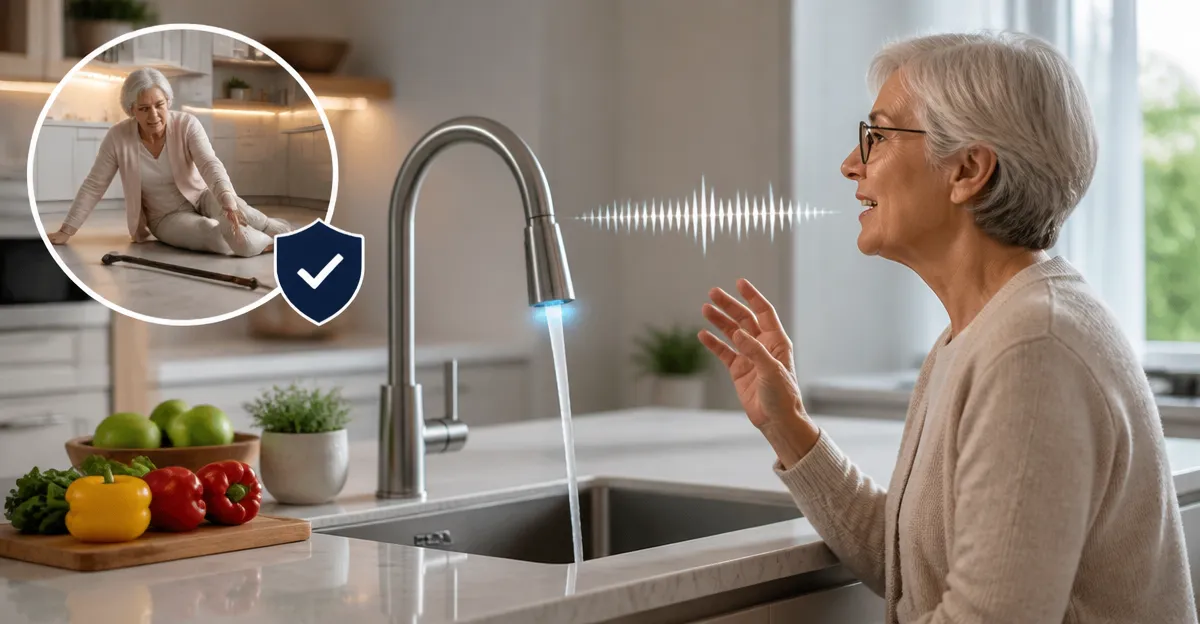
Kitchen falls represent a leading cause of injury among older adults, often occurring when reaching for handles or adjusting water temperature. Voice‑activated, or touchless, faucets promise hands‑free operation, potentially reducing the need for precarious movements. This guide examines the relationship between smart faucet technology and fall prevention, offering evidence‑based insights and actionable recommendations. Readers will understand core concepts, evaluate leading products, and apply best‑practice strategies to create a safer cooking environment.
Background and Context
Older adults frequently experience reduced balance, slower reaction times, and diminished grip strength, which together increase susceptibility to slips and trips in the kitchen. According to the Centers for Disease Control and Prevention, one in four adults aged 65 and older experiences a fall each year, with many incidents occurring near sinks and countertops. Traditional faucets require manual twisting and pulling, actions that can destabilize a person standing on a stool or reaching across a crowded basin. Emerging touchless technologies replace these motions with motion‑sensor activation, allowing water flow to start and stop with a simple hand wave or voice command.
How Voice‑Activated Faucets Work
Voice‑activated faucets integrate infrared or ultrasonic sensors that detect motion within a defined range, triggering a solenoid valve to open and deliver water. Some models incorporate Bluetooth or Wi‑Fi modules that enable voice assistants such as Amazon Alexa or Google Assistant to control temperature and flow through spoken commands. The sensor typically operates on battery power, with a manual lever retained for situations when batteries are depleted. Advanced designs also feature temperature‑indicating LEDs, providing visual cues about water heat without requiring physical contact.
Fall Risks in the Kitchen for Seniors
Common fall scenarios involve reaching for a faucet handle while standing on a step stool, bending over a deep sink to clean dishes, or juggling hot water while holding a pot. Slippery surfaces caused by splashing water further exacerbate the danger, especially when floor mats are absent or poorly secured. Additionally, the need to adjust temperature manually can lead to prolonged exposure to hot water, increasing the likelihood of sudden movements that destabilize the user. Understanding these risk factors highlights why hands‑free operation can be a critical safety improvement.
Safety Benefits of Smart Faucets
By eliminating the need to grip a handle, touchless faucets reduce the physical effort required to start and stop water flow, thereby lowering the chance of a loss of balance. Motion sensors allow users to keep both hands free for stabilizing themselves on a sturdy surface or for carrying items, which is particularly valuable for individuals using walkers or canes. Temperature‑indicating LEDs provide immediate visual feedback, preventing accidental burns that could trigger a reflexive jerk and a subsequent fall. Moreover, many smart faucets incorporate auto‑off timers that shut off water after a preset period, reducing the risk of water‑related slips.
Product Recommendations
Two highly rated touchless faucets demonstrate the safety features discussed above. The OWOFAN Touchless Kitchen Faucet offers a motion sensor, dual‑function spray, and a water‑powered three‑color LED that signals temperature without batteries. Its brushed‑nickel finish resists fingerprints and corrosion, while the ceramic disc cartridge is rated for 500,000 cycles, ensuring drip‑free reliability. Priced at $118.98 and supported by 4.5‑star ratings from over twenty‑one thousand reviews, this model is suitable for both single‑hole and three‑hole sinks, allowing flexible installation.
The FORIOUS Touchless Kitchen Faucet provides an advanced motion sensor with a three‑minute auto‑off timer, three spray modes, and a high‑arc spout with an 18‑inch retractable hose for comprehensive sink coverage. Constructed from SUS 304 stainless steel and featuring a five‑layer nanotechnology finish, it resists fingerprints and is easy to clean. With a price of $103.96 and a 4.6‑star rating from nearly twenty‑nine thousand reviewers, this faucet emphasizes water efficiency, delivering 1.8 gallons per minute while saving approximately twenty percent of water compared with conventional models.
Comparison and Selection Guide
| Feature | OWOFAN Touchless Kitchen Faucet | FORIOUS Touchless Kitchen Faucet |
|---|---|---|
| Price | $118.98 | $103.96 |
| Average Rating | 4.5 / 5 (21,878 reviews) | 4.6 / 5 (28,968 reviews) |
| Installation | Fits 1‑hole and 3‑hole sinks; deck plate included | Fits 1‑hole, 2‑hole, and 3‑hole sinks; detachable deck plate |
| Sensor Power | Battery‑powered (replaceable) | 4 AA batteries (not included) |
| Temperature Indicator | Water‑powered LED (blue, green, red) | No built‑in LED; relies on voice feedback |
| Spray Modes | High‑pressure spray and aerated stream | Stream, Spray, Pause |
| Water Flow Rate | Standard flow (approx. 2.2 GPM) | 1.8 GPM, 20 % water savings |
| Finish | Brushed nickel over stainless steel | Five‑layer nanotech brushed nickel |
When selecting a faucet, seniors should prioritize features that directly address fall risk, such as reliable motion detection, clear temperature indication, and easy‑to‑reach controls. Users who value water conservation may lean toward the FORIOUS model, while those who prefer visual temperature cues may find the OWOFAN LED system more reassuring. Installation complexity is comparable for both products, but households with existing three‑hole configurations may appreciate the flexible deck plates offered by each manufacturer.
Best Practices & Tips for Maximizing Safety
- Position the sensor at a height that aligns with the typical hand‑wave range, usually 12‑18 inches above the sink basin.
- Maintain a dry, non‑slippery floor by using absorbent mats and promptly wiping any spills that occur during faucet activation.
- Test the auto‑off timer regularly to ensure the faucet shuts off after the intended interval, reducing the chance of unexpected water flow.
- Combine the touchless faucet with a sturdy, anti‑slip step stool that features handrails, allowing safe reach for high‑mounted sinks.
- Schedule periodic battery replacements or use rechargeable battery packs to avoid sensor failure during use.
- Educate all household members on the correct hand‑wave distance and voice command phrasing to prevent accidental activation.
Frequently Asked Questions
- Do voice‑activated faucets work for users with limited mobility? Yes, because they eliminate the need to twist a handle, allowing individuals who rely on walkers or canes to operate the faucet with minimal effort.
- Can the motion sensor be triggered unintentionally? Modern sensors include adjustable sensitivity settings that reduce false activations from nearby movement, and many models feature a short activation window to further limit accidental water flow.
- What happens if the batteries die? Both featured faucets retain a manual lever that provides full temperature and flow control, ensuring water can still be used even when the sensor is offline.
- Are touchless faucets compatible with voice assistants? Some models integrate Bluetooth or Wi‑Fi modules that allow direct control through Alexa, Google Assistant, or Siri, though the two products highlighted rely primarily on motion detection rather than voice integration.
- Do these faucets affect water pressure? Touchless faucets typically maintain standard pressure; the FORIOUS model even advertises a reduced flow rate of 1.8 GPM, which conserves water without noticeably compromising performance.
- Is professional installation required? Both faucets are designed for DIY installation with step‑by‑step instructions and all necessary hardware, making professional assistance optional for most homeowners.
- How often should the LED temperature indicator be cleaned? A soft, damp cloth is sufficient; the brushed‑nickel finish resists fingerprints, and the LED housing is sealed to prevent water ingress.
Conclusion
Voice‑activated faucets present a compelling solution to reduce kitchen falls among seniors by removing the need for manual handle manipulation and providing clear temperature feedback. The OWOFAN and FORIOUS models illustrate how sensor reliability, ergonomic design, and water‑saving features can be combined to enhance safety without sacrificing functionality. By following best‑practice guidelines, selecting a faucet that aligns with individual needs, and maintaining a clean, non‑slippery environment, households can create a kitchen space that supports independence and reduces injury risk.
Products Featured in This Guide
OWOFAN Touchless Kitchen Faucet
Price: $118.98
Rating: 4.5 out of 5 stars (21,878 reviews)
Featured for its motion‑sensor activation, dual‑function spray, and water‑powered three‑color LED that instantly communicates temperature, making it especially useful for seniors who need visual cues to avoid burns.
FORIOUS Touchless Kitchen Faucet
Price: $103.96
Rating: 4.6 out of 5 stars (28,968 reviews)
Featured for its three‑minute auto‑off timer, three distinct spray modes, and water‑efficient 1.8 GPM flow rate, offering seniors both safety and conservation benefits.